Saturday, January 2, 2016

Claus von Stauffenberg: The Man Who Tried to Kill Hitler

Claus von Stauffenberg
Claus von Stauffenberg was a colonel in the German army during Hitler’s reign. He was a dedicated patriot and, by all accounts, a very intelligent man. He was a born aristocrat and able soldier. In spite of all of these accomplishments, and for good reason, he is better known as the man who almost killed Adolph Hitler.

Claus von Stauffenberg was born on November 15, 1907. He was the third son of Alfred Schenck Graf von Stauffenberg and Caroline Grafin von Uxkul-Gyllenband. He had a twin named Konrad Maria, who died the day after they were born. He had two older brothers, who were also twins. Their names were Alexander and Berthold.

During his childhood it was clear that Claus von Stauffenberg was a lover of the arts. He was a talented musician and once thought that he may follow this as a career. He was also a lover of poetry and a follower of the famous German poet George Stefan. Claus also dreamed of one day becoming an architect. In the end, he put aside his dreams of being an artist and instead became a military man.

Claus von Stauffenberg began his officer’s training in 1926, at the age of nineteen. Seven years later, he married Elisabeth Magdalena Vera Lydia Hertha Freiin Von Lerchenfeld or Nina for short. The couple had five children together, Berthold, Heimaran, Valerie, Franz Ludwig and Konstanze. Konstanze was born after Claus von Stauffenberg’s death.

In 1936 Claus von Stauffenberg began studying at the War Academy in Berlin. He graduated in 1938 and was given the post of quartermaster in what was to become the 6th Panzer Division. He went on to gain extensive experience while serving in several major campaigns during WWII. He began to doubt the tactics of the German military under Hitler’s command, though his patriotism never faltered.

It was during Operation Barbarossa (an attack on Russia) in 1941 that Claus von Stauffenberg began to express his disgust at the German military’s treatment of POWs and the Jews. He began voicing his opinion in an attempt to find like-minded men. Rumor has it that, at this time, he told people that Hitler would have to die and that the government would have to be overthrown. It is also said that Claus mentioned that he didn’t care if he had to be the man to kill the fuhrer.

In 1943, Claus von Stauffenberg joined the 10th Panzer Division in Africa. In April of that year, he was shot and severely wounded by Allied aircraft at Sebkhet en Noual in North Africa. He lost his left eye, two fingers of his left hand and his entire right hand during the shooting and subsequent surgeries. He recovered from his injuries quickly and was promoted to Colonel. He was also appointed Chief of Staff to the Reserve Army command under Friedrich Fromm.

In this new capacity, Claus von Stauffenberg was able to attend Hitler’s briefings. This came in handy, as he had joined a group of men that were planning a coup that would overthrow Hitler’s government. The plan was to kill Hitler, the head of the S.S., Heinrich Himmler and the Commander and Chief of the German Air Force, Hermann Goering. After the assassinations, the conspirators would then cut off communications from Hitler’s men and assume control of the army. It was decided that Claus von Stauffenberg would be the man to carry out the assassinations.

Claus von Stauffenberg made the first attempt to place a bomb at one of Hitler’s briefings on July 11, 1943. The plan was aborted because of unexpected complications. This happened a second time on July 15. Stauffenberg finally succeeded in detonating a bomb at a briefing at Hitler’s hideout, Wolf’s Lair, on July 20. Believing the fuhrer was dead, Claus left the hideout and attempted to follow through with the plan. Unfortunately, his co-conspirators failed to mobilize within the first few hours while Stauffenberg was traveling.

Claus von Stauffenberg tried desperately to follow through with the plan, despite the failure of some of the men involved in the coup. However, it was soon announced on the radio that Hitler had not died in the blast. Claus was not only surprised to hear this, but he now knew that all had been lost. With Hitler still alive, there was no way his followers were going to follow new leadership.

Claus von Stauffenberg was arrested that night and executed in the courtyard of the War Ministry in Berlin. His brother, Berthold, who was another conspirator, was also arrested. He was later hanged. Claus’ wife was also arrested and his children were placed in the care of the Nazis. Nina’s uncle “Nux” was also arrested as a conspirator and he was later executed. Luckily, Nina was spared; she gave birth to the couple’s last child while imprisoned by the Nazis.

Nine months after the attempted coup d’etat, Hitler committed suicide. Nina was released from a women’s concentration camp, where she had been held. She was reunited with her elder children one year after her husband’s death.

Sources

Claus von Stauffenberg, retrieved 7/26/09, jewishvirtuallibrary.org/jsource/biography/Stauffenberg.html

Berthold von Stauffenberg, retrieved 7/16/09, economicexpert.com/a/Berthold:von:Stauffenberg.html

Claus Schenck Graf von Stauffenburg, retrieved 7/16/09, imbd.com/name/nm1533515/bio


Friday, January 1, 2016

Dr. Eugene Lazowski: Hero of the Holocaust

Dr. Eugene Lazowski
Photo via Wikipedia
Dr. Eugene Lazowski was a Polish doctor and soldier during World War II. He was also a member of the Polish Underground Army and the Red Cross. He was one of the many heroes of the Holocaust whose humane deeds were conducted in secret and at great risk to themselves. He worked in a number of different ways to help the people in his neighborhood who were persecuted by the Nazis, all of which he could’ve been executed for.

Dr. Eugene Lazowski was born in Poland in 1913. He was in his twenties when he first came to Rozwadow, Poland. He was placed in a POW camp there. He bravely escaped the camp, narrowly avoiding a German guard.

Eugene had a home next to the ghetto in Rozwadow. In fact, his fence bordered the ghetto, which was filled with his fellow countrymen, many of them Jews. The ‘residents’ of the ghetto were sadly undernourished and some of them were very ill. Despite the fact that the Germans had declared it a crime to help these people, a crime that was punishable by death, Dr. Eugene Lazowski came up with a way to treat the sick in the Rozwadow ghetto. He would have them come to his fence, under cover of night, and tie a white cloth to it. When he saw the cloth, he would come out to the fence and treat whoever was there. He was able to supply his covert medical operation by cleverly falsifying his inventory.

Dr. Eugene Lazowski was given the opportunity to assist these people more, when his colleague, Dr. Stanislaw Matulewicz, made an amazing discovery. If he injected healthy patients with the same dead bacteria that was used to test for typhus, their tests would come back positive for the disease, with no harm done to them. The Germans were terrified of contracting the disease, so if a patient was found to have it, that would make them exempt from transfer to labor and concentration camps. There was one problem, however.

During the time of the Nazi occupation of Poland, Jews who were discovered to have deadly communicable diseases were killed and their homes burnt to the ground. If Dr. Eugene Lazowski and Dr. Matulewicz were going to help, they would only be able to use the bacteria on non-Jewish patients. They first tested it on a man who was home on leave from a labor camp. It worked. The test came back positive and the man did not have to return.

The doctors began slowly ‘spreading’ the disease throughout Rozwadow and the surrounding villages. They were very careful not to ‘infect’ Jews and they made sure that some of the ‘infected’ were referred to other doctors, who did not know of the deception, for testing. This way, all of the tests were not coming from them. That would have been too obvious.

Once there were enough cases of the disease, which is transmitted through the bite of infected lice, the Germans quarantined the area. No more people were taken out of the area and placed in camps. Dr. Eugene Lazowski was allowed to continue ‘treating’ the ‘epidemic’ and so, he was able to perpetuate it for nearly three years. During that time, the Germans only came to inspect the area once. Their fear of the disease prevented them from doing a thorough job of it and so the deception was not discovered.

Close to the end of World War II, a soldier whom he had secretly treated for a venereal disease warned Eugene Lazowski that the Gestapo was after him. The soldier told him that they were aware of him treating members of the resistance and had known for some time. Eugene later speculated that they had known about him, but had allowed him to live so that he may contain the ‘epidemic.’ So, in a way, Eugene had not only saved an estimated 8,000 people with the ‘epidemic,’ but he had also saved himself from execution.

When the doctor heard that the Gestapo was seeking him, he grabbed his wife and daughter and fled the city. He moved to the United States in 1958 and became a professor at the University of Illinois Medical Center. Dr. Eugene Lazowski passed away in Oregon in December of 2006.

Sources

Fake Epidemic Saves a Village from Nazis, retrieved 1/19/10, holocaustforgotten.com/eugene.htm

He Duped Nazis, saved thousands, retrieved 1/19/10, st.joen.net/lazowski/lazowski.html

Wednesday, December 30, 2015

Doris Payne: International Jewel Thief

Diamond ring
Doris Payne is a sucker for a diamond.
Doris Payne is a woman whose life would make a great movie. Seemingly sweet, charming and rich, Doris Payne is a woman that no one would suspect of wrongdoing. This fact has kept her in the international jewel thief business for roughly half a century.

Doris Payne was raised in West Virginia. She was the youngest of six children born to a poor coal miner and a housewife. Growing up, she learned that being black and a girl meant she did not draw the type of attention that a well-to-do white woman did. In other words, clerks did not pay enough attention to her to notice if she was stealing from them or not. She did not use this knowledge until she realized something else. Clerks paid her the right kind of attention if she dressed like a rich black woman. Money talked and, if she pretended she had it, she could get clerks at jewelry stores to make every effort to impress her. If she played her cards right, she could wow them with her charm and well-to-do looks and then walk right out of the store with expensive jewelry–typically diamond rings.

After Doris Payne graduated high school, she was pregnant, working at a nursing home and trying to help her mother following her parents' divorce. She already knew her con; she just had to put it into action. Once she did, she became a prolific thief, stealing rings that were worth tens of thousands of dollars and selling them for a fraction of the retail value. She never went back to having an honest vocation again.

Interpol has reportedly been on to Doris Payne since the 1970s. She has allegedly had as many as 20 identities, at least five with their own social security numbers. She has worked in several of the United States and countries abroad. She has also been arrested countless times and has been jailed at least six times. She is currently 80-years-old and serving a five-year prison sentence.

On January 1, 2010, Doris Payne stole a diamond ring worth 9,000 dollars from a department store. As usual, she dressed like a rich woman and conned the clerk into showing her numerous pieces. She then simply walked out of the store with the ring. She was caught and in February of 2011, she was sentenced to five years in prison for the theft. She will be 85 when she gets out. Authorities believe that she will not stop stealing until she is dead. It looks like they are right.

Update: Payne was arrested again in 2015 for stealing a pair of earrings. She is also wanted for stealing a ring. 

As much of a career criminal as Doris Payne is, she is not a violent woman. All of her cons have simply been cons and thefts. She has never used violence to steal. That is probably what has kept her from serving longer jail sentences. Her crimes appear to be compulsory. It may be that she is simply addicted to the game. In that case, she is not a very bad person. She is just a person who makes very bad choices.

Sources

ABC News, International Jewel Thief, 80, Sentenced to 5 Years, retrieved 5/21/11, abcnews.go.com/Blotter/international-jewel-theif-doris-payne-80-sentenced-years/story?id=12883316


MSNBC, 75-Year-Old Jewel Thief Looks Back, retrieved 5/21/11, msnbc.com/id/10072306/print/i/displaymode/1098

Tuesday, December 29, 2015

Constantin Brancusi: Turn of the Century Sculptor

Constantin Brancusi
Constantin Brancusi circa 1905
Constantin Brancusi was one of the first artists to ever really delve into the abstract style of sculpture. His sculptures are simplistic and artfully geometrical yet unique and inspiring. A lot of his work is reminiscent of art in some of the ancient cultures of Asia and Africa, though less religious in meaning. Today Constantin Brancusi is thought of as the leading pioneer of abstract sculpture.

Constantin Brancusi was born in Hobitza, Gorj, Romania on February 19, 1876. He showed a desire to sculpt materials that he had access to from a very young age. It is said that he would take small pieces of wood and carve them into animals when he was a boy.

This love for art prompted Brancusi to obtain a large amount of education concerning all kinds of art, including architecture. He began his study of art in 1894 at the Scoala de Meseru in Craiova. He went on to study at the Scoala Nationala de Arte Frumoase in Bucharest in 1891. Following his education there he moved to Paris where he studied at the Ecole des Beaux Arts, beginning in 1905.

After school, Constantin Brancusi decided to remain in Paris. It was there that he sculpted his now famous works, The Kiss and The Muse. Constantin Brancusi’s first exhibit was held in Paris in 1906. He opened a shop there, where he lived and worked from 1925 to 1957. He became immersed in the art scene there and even created sculptures for the graves of some artists in Montparnassee Cemetery who had committed suicide.

The works of Constantin Brancusi were not only popular in Europe, but many of his pieces were showcased in exhibits in New York City as well. Some of his work was first showcased in New York City in 1913, from that time on he exhibited his work both in Europe and the United States. He became very popular in both scenes and remained so until his death in March of 1957. He died in Paris, the city that he had come to call home and is buried there at Montparnassee Cemetery.

Selected works by Constantin Brancusi

The Kiss (arguably his most famous piece) (limestone) (1908) Currently housed in the Philadelphia Museum of Fine Art

Mademoiselle Pogany (white marble) (1912) Currently housed in the Philadelphia Museum of Fine Art

Bird in Space (carved out of marble and finished with polished bronze) (1924) Currently housed in the Philadelphia Museum of Fine Art

A Muse (bronze) (1918) Currently housed in the Portland Art Museum in Oregon

Sources

Constantin Brancusi, retrieved 8/9/09, biography.com/articles/Constantin_Brancusi-9224236

Constantin Brancusi Biography, retrieved 8/9/09, biographybase.com/biography/Brancusi_Constantin

Sunday, December 27, 2015

Citizen Kurchatov: Soviet Nuclear Physicist

Kurchatov Monument
Courtesy of Andrey Zakharov
Citizen Kurchatov was a nuclear physicist who was enlisted by Josef Stalin to make the Soviet Union's first atomic bomb. He worked on the project during arguably the most dangerous time to be a scientist in the Soviet Union and somehow managed to keep himself and his team alive under Stalin's demanding regime. In fact, his work for Stalin lasted longer than Stalin's rule.

Citizen (Igor) Kurchatov was born in the southern Ural Mountains in January of 1903. At the time Igor was born, Russia was still Russia and it was still ruled by the Royal Family, namely the Romanovs. Kurchatov was 11 years old when Tsar Nicholas decided to fight Germany in World War I. This decision, among others, changed the history of Russia. Rebellion was already brewing and those who did not believe in the war thought it was time to overthrow the Romanovs.

Roughly three years later (1917), Nicholas was deposed. Shortly after, Vladimir Lenin and the Bolsheviks took control of Russia and transformed it into the Soviet Union. They also removed Russia from the war. Igor took no part in this revolution or the war. In fact, he was still a school age boy when this was occurring. Nonetheless, this coup would shape the rest of Igor Kurchatov's young life, along with his decision to study physics. He began attending Crimea State University in 1920. It took him only three years to earn his degree in physics. He went on to study shipbuilding and do research at the Pavlovsk Observatory while he attended the Polytechnic Institute in Petrograd.

While Igor was stepping into his role as a research physicist, Josef Stalin was dumping the country's funds into technological and scientific projects that did little to help his starving people. Not that starving people were ever a concern of Josef Stalin. His main concern was seeing to it that all of the scientists and workers who were under him were making progress. Working under the tyrannical rule of Josef Stalin was a choice between success, labor camps (gulags) or death. Kurchatov's next career choice ensured that he would be one of the scientists struggling to make things happen for Stalin. Igor Kurchatov decided to focus on nuclear physics and he quickly made a name for himself in the field. 

In 1938, the race for the world's first atomic bomb began with the splitting of a uranium nucleus. Oddly, Stalin did not focus his thirst for technological advantage on creating this bomb. He did not really believe it was happening. The United States, England and Japan started atomic bomb projects as soon as possible while Stalin pondered the idea. He was not bothered by their arms race because he had a (seemingly tenuous) treaty with Germany.

In 1941, the German Army launched Operation Barbarossa - a surprise invasion of the Soviet Union. Stalin was now in the thick of World War II. Initially, he continued to ignore the race for the atomic bomb. The brilliant young Citizen Kurchatov worked on naval defense and armor projects, while Stalin considered the possibility of starting a nuclear weapon's project. Eventually, he decided to start on a small scale, just in case. After some deliberation, Kurchatov was put in charge of the project. He assembled a team and began testing research that the Soviets had stolen from England.

Citizen Kurchatov had roughly 100 researchers on his project in its infancy. The United States had hundreds of thousands of researchers working on nuclear weapons research. Kurchatov needed more funding, so he wrote to the Soviet chief of security, a formidable man by the name of Lavrenti Beria. In doing so, Citizen Kurchatov went past his superior to the top, but he knew he needed Beria's help. He could not make the weapons without more funding and he knew the pressure would come down from Stalin fast when another country beat them to the bomb. He was right.

While Kurchatov was trying to get more funding, the Allies defeated Hitler's army. The Soviet Union basked in the glory of victory and Kurchatov's project remained underfunded until the United States dropped an atomic bomb on Hiroshima, Japan on August 6, 1945. As a result, Kurchatov got a meeting with Josef Stalin himself, who told him that he needed to produce an atomic bomb in three years - an astoundingly short amount of time - and that he would have everything he needed to do it. Kurchatov took the extra funding and ran with it. Soon, he had a massive project underway that included mines, reactors and an entire city of laboratories and scientist living quarters.

Kurchatov and his army of new researchers worked under the watchful eye of Beria, who was very threatening. Stalin had to tell him, "Leave the physicists alone. We can always shoot them later." Luckily, Kurchatov was a productive man. On August 29, 1949, he tested the Soviet Union's first atomic bomb. Kurchatov and three of his teammates were given the Stalin Prize for their achievement. Now, the race was on for the first hydrogen bomb.

The U.S. detonated the world's first hydrogen bomb on October 31, 1952. Stalin died a few months later and Khrushchev began to take control. Beria was sentenced to death for supposed crimes and Kurchatov simply continued his work. He tested a hydrogen bomb on August 12, 1953 and it worked. His next test was in November of 1955. This test resulted in the deaths of three people when a building collapsed from the force of the bomb. Kurchatov refused to supervise a test again. From the on, he turned the bulk of his efforts to less dangerous uses of nuclear energy.

A few months after the bomb incident, Khrushchev took his pet scientist to England to speak with scientists there and see research centers in England. Upon their return, Kurchatov had a stroke, which was followed by another one in 1957. He died roughly three years later of an aneurism. He was buried in the Wall of Kremlin.

Sources

Citizen Kurchatov, retrieved 11/5/10, pbs.org/opb/citizenk/index.html

Saturday, December 19, 2015

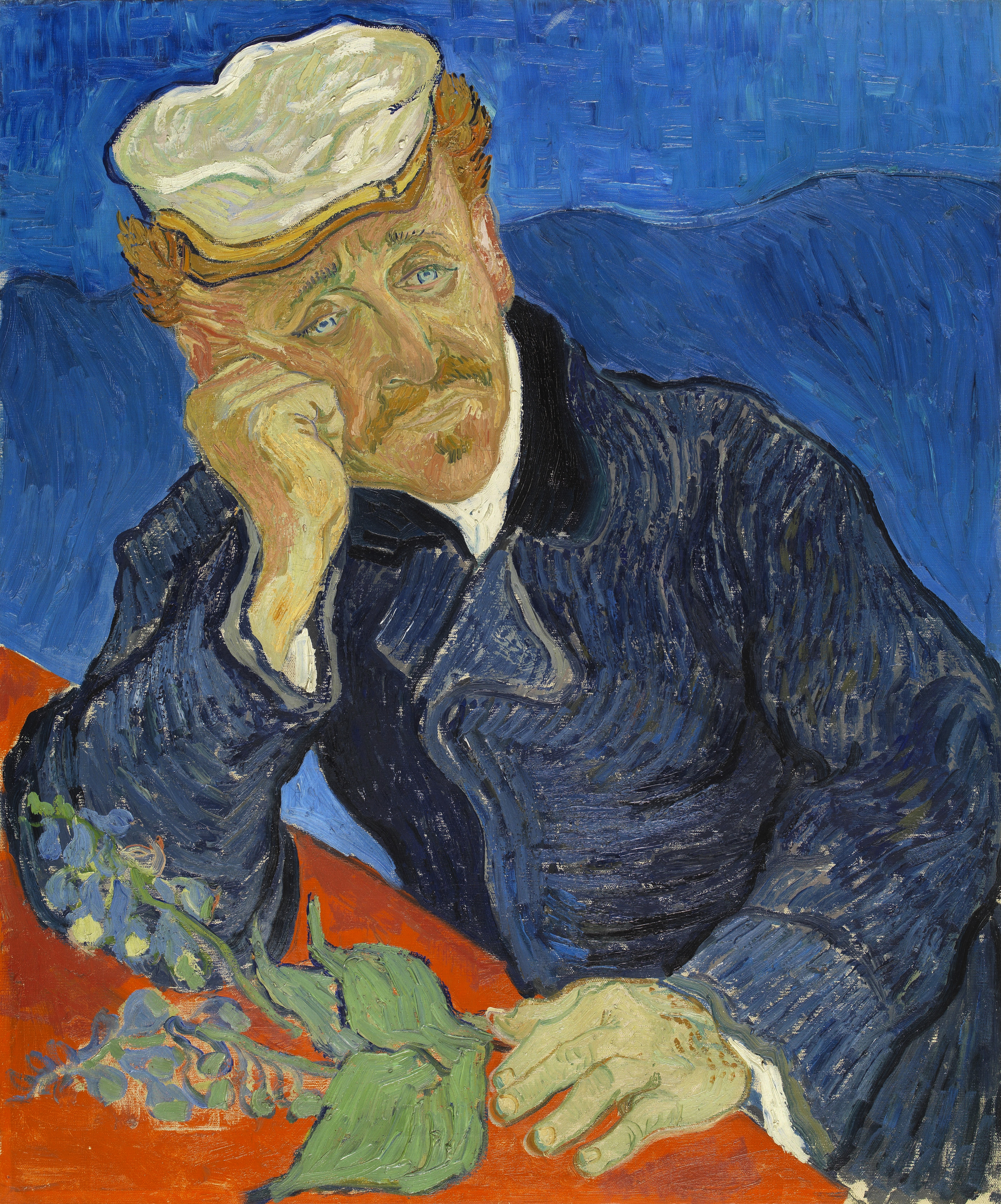
Doctor Paul Gachet: Van Gogh's Physician

Doctor Paul Gachet, as painted by
Vincent Van Gogh
Doctor Paul Gachet was the last personal doctor employed by the great post-impressionist painter, Vincent Van Gogh. He was a mysterious man, in a way. Vincent did a gloomy etching of the physician, not long before he died. That etching and his treatment of Vincent landed Dr. Paul Gachet in the pages of history, but very little is known about the man himself.

In May of 1890, Vincent van Gogh moved to Auvers-sur-Oise, where he could be closer to his brother. He had just gotten out of an asylum for the mentally ill (he admitted himself) and he was in need of some recuperation. However, he was still in need of medical supervision, as his mental condition was hardly getting any better. Doctor Paul Gachet was recommended to him and began working for him that month.

Paul Gachet was an avid lover of the arts and an aspiring artist himself. He spent time among such men as Victor Hugo and Gustave Courbet. Vincent’s brother Theo, who was very close to the artist, thought that Gachet was a good choice, considering his love of art. Some people believe that Theo was wrong, given the events that followed.

Vincent became agitated during his time in Auvers-sur-Oise, but was also very productive. He created the etching, his first and only etching, of Doctor Paul Gachet while he was there, as well as other paintings. During this time he said this of his physician “sicker than I am, I think, or shall I say as much . . . ”

What did Vincent mean when he said this about his doctor? Some people believe that Doctor Gachet was not fit to treat Vincent and that Vincent knew that. Could these words have revealed a truth about the doctor, of which no one else was aware? Could Paul Gachet have been mentally or physically ill while he was treating Vincent van Gogh? There is also the possibility that these words were the blathering of a man who was a brilliant artist, but also very strange and suicidal. Unfortunately, no one was ever able to find out what the artist meant by his words.

On July 27, 1890, Vincent van Gogh went into a field to paint and shot himself in the chest with a revolver. He managed to make it back to his room and Dr. Gachet was summoned. The wound was inoperable and so Vincent died two days later with his beloved brother by his side. Some of his last words to Theo were “The sadness will last forever.” Theo himself died six months later.

Whether or not Doctor Paul Gachet should have been able to prevent the 37-year-old artist from killing himself, seems to be a matter of speculation. Some people believe that there is some mystery surrounding the doctor’s inability to do just that. However, Vincent van Gogh was suicidal for many years before he met Dr. Gachet and the doctor had only treated him for a few weeks before his death.

We know now that a few weeks is not sufficient to treat such a deep seated mental illness, which may have been coupled with epilepsy. It would seem that Doctor Paul Gachet was just a melancholy-looking fellow who was treating the wrong patient at the wrong time. For that, he is sometimes scrutinized. However, this may simply be due to the lack of information about the relationship between the patient and doctor and a lack of clarity regarding some of the patient’s words.

None of Vincent’s family held Doctor Paul Gachet responsible for the painter’s death. In fact, Theo’s wife even had her husband and brother in law’s graves decorated with ivy from the doctor’s garden. That very same ivy is there to this day.


Friday, December 18, 2015

Doc Holliday: Wild West Legend

Doc Holliday
Doc Holliday
John Henry Holliday, or more commonly Doc Holliday, was a famous western gunslinger and friend of Wyatt Earp. He was a bit of an outcast among the men of the wild west. He was a dentist, fluent in Latin and French, he could play the piano really well and dressed well too. However, he was also quick on the draw, a great gambler and notoriously brave, although the bravery may have stemmed from the fact that he was dying of tuberculosis. No matter the cause of his bravado, he will always be remembered for it and his odd personality.

John Henry Holliday was born in late 1851 or early 1852, in Griffin, Georgia; sources conflict as to the exact date of his birth. He was the son of Major Henry Burroughs Holliday and Alice Jane McKey. When John Henry was around five years old, the Holliday’s moved to Valdosta, Georgia. He attended grade school in Valdosta, where he learned some Greek, Latin and French. His mother taught him to play the piano when he was a young boy. She died of tuberculosis when John Henry was only 12 years old. Some historians believe that Doc contracted his tuberculosis from Alice.

John Henry Holliday attended the Pennsylvania College of Dental Surgery and graduated in 1872. This is how he earned his nickname. He supposedly loved being a dentist, but had hard time finding work with his cough. That is one of the suspected reasons that he moved out west as well, which he did soon after graduation.

In 1875, Doc Holliday had his first run in with the law in the west. He was involved in a shootout with a local barkeep in Dallas, Texas. Neither of the men were hurt, but they were both arrested. It was around this time that Doc began developing a bit of a reputation for himself. He was involved in many gunfights in his lifetime and it was also remarked that he acted like he didn’t care if he lived or died. He also developed a reputation as a capable gambler. In 1877 Holliday went to Dodge City, Kansas, where he met up with his friend, Wyatt Earp.

Doc Holliday left Dodge City with Earp in 1879. They moved to Tombstone, Arizona where Earp became a deputy sheriff. During his time in Tombstone Doc was involved in the legendary shootout at the OK Corral. The shootout occurred on October 26, 1881. Soon after, Doc moved to Colorado.

John Henry “Doc” Holliday spent the last years of his life in Colorado. By 1887, his health had declined so much that he had to check himself into a tuberculosis hospital there. On November 8 of that year, Doc died of the disease at the age of 34 or 35. Some believe that he may have died because he drank so much, but it is unlikely that he drank enough to kill him by that age. It is more likely that his drinking combined with the tuberculosis did him in. It is rumored that the moment before he died, he looked down and his bare feet and said “this is funny.” He had always thought that he would die in a gunfight with his boots on.

Source

John Henry Holliday Family History, kansasheritage.org/families/holliday.html