Friday, December 30, 2016

James Bowdoin: Post-Revolution Governor of Massachusetts

Feke Painting of James Bowdoin
James Bowdoin was a Bostonian revolutionary during the tumultuous years of America' war for independence. Like many, his position of opposition against British rule was not his initial stance on the topic. His opinion slowly changed over the years and he eventually became a governor in post-war Massachusetts.

Bowdoin was perhaps not as popular as the governor who served before him,–John Hancock–but that may have had something to do with his apparent absence during the American Revolution. He was suffering from what modern historians believe was tuberculosis and was involved with the Massachusetts Provincial Congress, despite his illness. When he felt better, he got right back into politics on a bigger scale. As such, he belongs among the list of Boston patriots, regardless of how undecided and sick he may have been during the war.

James Bowdoin was born in Boston to Hannah and James Bowdoin on August 7, 1726. He was technically James Bowdoin II and is currently referred to as such, though his family didn't distinguish between the two in that manner. His parents were wealthy, thanks to his father's endeavors as a merchant. Bowdoin was able to attend Boston Latin and go on to further his education at Harvard College, from which he graduated in 1745.

Three years after graduation, James Bowdoin married Elizabeth Erving. Two children came from the marriage, one of which was James Bowdoin III, who played a role in starting Bowdoin College in Maine in his father's memory.

James Bowdoin was an active, thoughtful man. He was the owner of extensive tracts of land. He dabbled in being a merchant, science, politics and maritime rescue. He was the founder of the American Academy of the Arts and Sciences, of which he was the first president. He was a member of the Massachusetts Humane Society–the name of which today is associated with animals but that focused on rescuing survivors of shipwrecks during the American Revolution. He earned an honorary doctorate from the University of Edinburgh. Clearly, he was a well thought of man in many circles.

As for political endeavors, Bowdoin was involved with the royal government in Massachusetts as a member of the governor's council from 1756 to the start of the American Revolution. He was off for a brief period when he became vocal about his shifting political views. In 1770, he wrote, "A Short Narrative of the Horrid Massacre" about the so-called Boston Massacre. By then, he was clearly siding with the rebels.

Whether it had anything to do with his later political leanings or not is unclear, but James Bowdoin did befriend Benjamin Franklin. It is not known precisely when they met, but Bowdoin did know Franklin at least two years before his graduation from Harvard College. The two had an interest in science in common and would send letters back and forth about Franklin's experiments with electricity.

After the American Revolution ended, James Bowdoin recovered from a long flare up of tuberculosis and ran for governor of Massachusetts. He lost to John Hancock. Five years later in 1785, John Hancock resigned for the first time and James Bowdoin became governor. It is generally thought that Bowdoin lost the first campaign by a large margin because of his seeming disdain for the lower class. When Shay's Rebellion took place, he had no sympathy for the affected "common" people. This hurt his campaign, but clearly, he was popular enough to win the second time. Therefore, it may have simply been John Hancock's popularity that killed Bowdoin's first campaign. He was in office for two years before John Hancock became governor yet again. Bowdoin passed away just three years later on November 6, 1790.

Monday, December 5, 2016

James Otis: Lawyer and Patriot


James Otis is one of the Boston men who helped stoke the fires of revolution during the 1760s. In fact, some people may say that he is the man who lit the fire. He is not as well known and he was not as prolific in his speeches and political work as many of his fellow revolutionaries. However, he was among the most intelligent and dedicated of these men. Sadly, his years of dedication and public service ended tragically.

James Otis was born on February 5, 1725 in West Barnstable, Massachusetts to James Otis Sr. and Mary Otis nee Allyne. His father was in politics. James Otis Jr. attended Harvard College. He graduated in 1743, at the age of eighteen. From there, he went to study law under Jeremiah Gridley.

James Otis' career in law began in 1748. He practiced in Plymouth, Massachusetts. However, Plymouth did not have a great need for a lawyer at the time, so two years later, James Otis took his practice into Boston. There, he earned a name for himself as a great speaker and a highly intelligent man. During the 1750s, John won a case that earned him the largest sum ever paid to a lawyer in Massachusetts until that time. His career was looking very promising.

In 1755, James Otis married Ruth Cunningham. The couple would go on to have three children together, James, Elizabeth and Mary. At the time of their marriage, they were both loyalists. That would change for James. Ruth would remain loyal to England for the remainder of her life, which, as it turns out, was longer than James' was.

James Otis shared his wife's beliefs openly until 1961. Around that time, some British revenue officers were given the authority to search the homes and places of business of Boston merchants in search of smuggled goods. James Otis decided to leave his then current position as advocate-general and represent Boston's affected merchants, for free. When the case was heard in what is now known as the Old State House, James Otis gave a roughly five-hour-long speech, addressing this issue and much more. One of his focuses was the fact that colonists had to follow Parliament's laws when the colonists were not represented in Parliament. He lost the case. However, the impact his speech had can be summed up by what future president of the United States John Adams said later. He remarked that it was on that day in the Old State House that "the child independence was born."

Soon after James Otis gave his speech at the Old State House, he was elected to the Massachusetts General Court. In 1764, he became a leader of the Massachusetts Committee of Correspondence. That same year, he wrote his famous pamphlet, "The Rights of the Colonies Vindicated." A year later, he attended the Stamp Act Congress in New York City.

In 1769, James Otis made some negative comments in the Boston Gazette that were directed at a few revenue officers. One of those customs officers and some British military men found James a few days later and mercilessly beat him. He sustained a head injury that contributed to the decline of his mental health. James Otis was able to hold on to his sanity for long enough to sue his attacker. He was rewarded a sum of money, but he would not accept it. He also received a formal apology. He remained in public office for a few more years, but by the time the American Revolution began, he was insane and in the care of his sister, Mercy Otis Warren. His life would be dotted with a few brief periods of lucidity, but he was never the same man again. He did however contribute to the American Revolution in a way that you probably will not expect.

On June 17, 1775, James Otis, then 50-years-old, decided to procure a musket and walk to Breed's Hill. That day, on Breed's Hill, a battle was raging that would become known as the Battle of Bunker Hill. James Otis showed up for the battle, fought in it, and walked home. Obviously, his hopes for the future of the country followed him in his descent into insanity.

Most of the rest of James Otis' life was spent in Andover, Massachusetts. He was there on May 23, 1783 when he was struck by lightning and killed instantly. A brilliant and at times odd life ended there. James was buried at the Granary Burying Ground in Boston, Massachusetts.

Sources

James Otis, retrieved 5/22/10, famousamericans.net/jamesotis

James Otis, retrieved 5/22/10, u-s-history.com/pages/h1204.html

Friday, November 18, 2016

Samuel Adams: The Face of a Revolution


John Singleton Copley's
portrait of Samuel Adams
Samuel Adams was one of the founding fathers of the United States, a Boston revolutionary and the current face of Bostonian beer. He is inextricably linked with the Boston rebels who helped ignite the revolution in the years leading up to 1775 and the famous documents that severed the many ties between the colonies and England. Unlike most of his contemporaries, he was not a soldier, an inventor, a successful merchant, a tradesman or a plantation owner. His only interest and success was in politics, but it was not for lack of trying other things.

Samuel Adams was born in Boston on September 27, 1722. He was raised in Boston and schooled at Boston Latin, like most of his peers. Also like his fellow Boston patriots, he went to Harvard College, graduating with his masters in 1743. After graduation, he became a merchant, but he was terribly bad at it. He seemed uninterested in money, instead being interested in public service. His father was a politician, but also a successful businessman. Samuel would not follow his father's example in that regard.

In 1749, Samuel Adams married Elizabeth Checkley, who bore him two surviving children before dying in childbirth. In 1764, he married Elizabeth Wells, who cared for his children, but had none of her own. Elizabeth Wells is remembered in a way as the woman who put up with Samuel Adams. He made very little money in public service. He had some land and a house, but Elizabeth did some work from home to keep them with money while he gave speeches and attended to the masses. In 1756, he became a tax collector and actually lost money due to his ineffective tax collecting strategies.

When Samuel Adams' father died, Samuel also had to fight off the British over a banking scheme his father had. It was popular among the people, but deemed illegal by the British. Samuel Adams was on the brink of having to hand over his estate, but he prevailed and the British were eventually run out of town anyway. Samuel also received the run of his father's maltsing business after his death. That was another failure for Adams.

As history shows us, Samuel Adams was not some poor unfortunate who was just no good at anything. The brewing discontent in the colonies gave him the perfect opportunity to showcase his talents. When Christopher Sieder was shot, Samuel Adams was quick to publicize the incident. Some say his speeches were such that he was something of an agent provocateur, though on the same side as those provoked. Indeed, the Boston Massacre occurred little more than a week after the event. Samuel Adams was also giving speeches before the Boston Tea Party. Suspicious? Historians think so. One thing is certain, instigator or not, he was one of the best orators in Boston before the American Revolution.

In 1765–five years before the Boston Massacre–Samuel Adams became a member of the Massachusetts Assembly. As revolution became inevitable, he served on the Massachusetts Provincial Congress and later the Continental Congress. He was positioned politically to be one of the men instrumental in creating the new nation. He signed the Declaration of Independence and helped draft the Articles of the Confederation.

In 1781, Samuel Adams retired from Congress and helped develop the Massachusetts Constitution. Eight years later, he became Lieutenant Governor. Five years after that, he became the Governor of Massachusetts. He remained governor until his health dictated that he rest in 1797. He died in Boston on October 2, 1803.

Wednesday, October 19, 2016

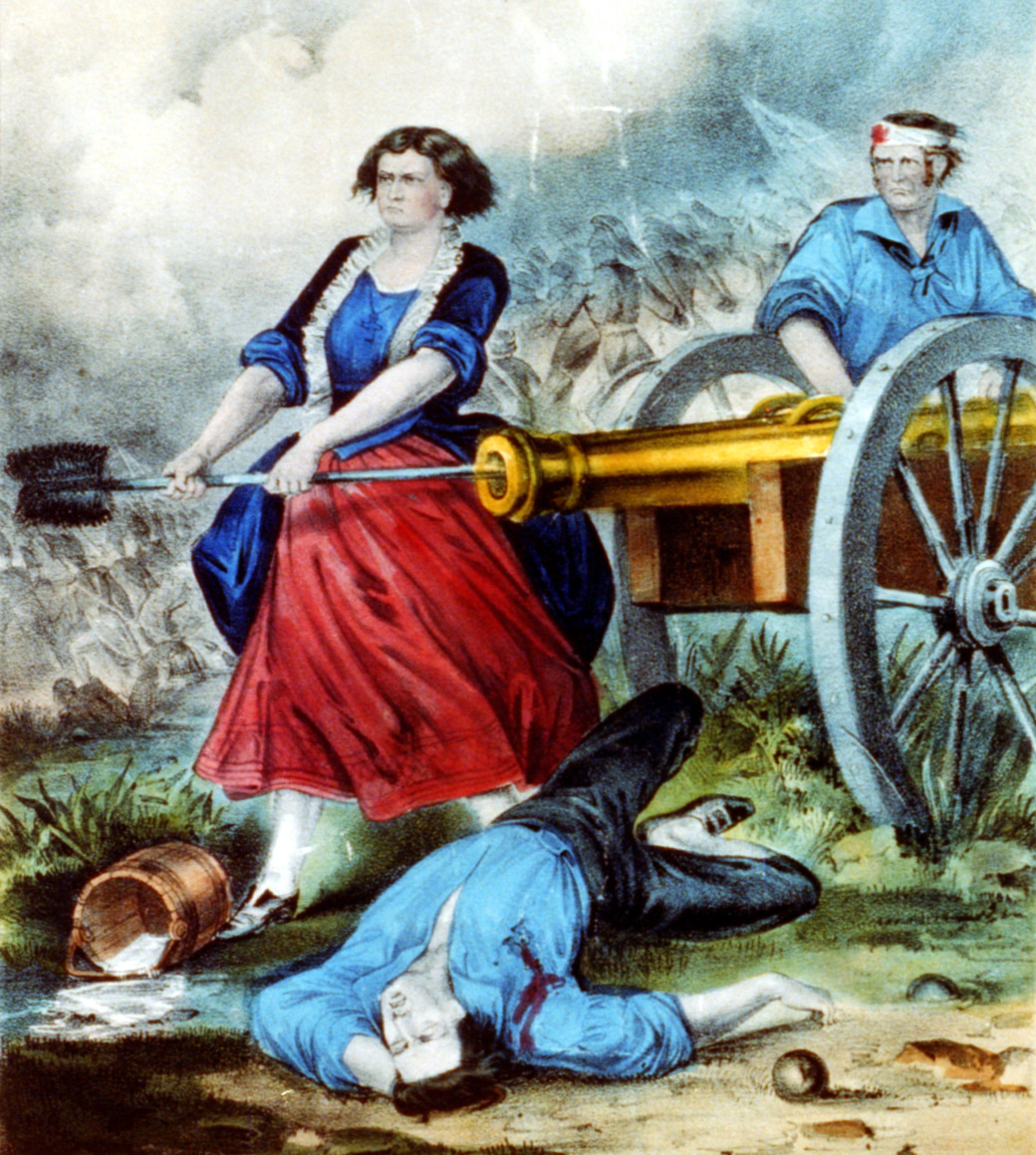
Mary Hays McCauley: Revolutionary War Hero


Currier and Ives painting
of Molly Pitcher
Mary Hays McCauley was an American Revolution heroine who earned herself the nickname “Molly Pitcher” for her brave actions during the Battle of Monmouth. Her dedication and fearlessness are legendary.

Molly Pitcher was born near Trenton, New Jersey on October 13, 1754. Her parents were German immigrants, whose names are not known. Her maiden is not known for certain either, but it may have been Ludwig.

In 1769, at the age of fifteen, Mary Hays McCauley went to work for future Colonial Army colonel and Brigadier General, Dr. William Irvine. She worked in his household as a maid, but she was not happy in her position. She soon fell in love with a barber named John Casper Hays and left her place of employment to marry him. John soon enlisted in the artillery of the Continental Army. When John went off to war, Mary followed.

During the Revolutionary War, it was common for women to follow their men so that they may do chores such as washing and cooking for them. They were also handy for tending the wounded. Mary Hays McCauley was present with her husband at Valley Forge, but it was at the Battle of Monmouth that she proved that she could do far more than cook and clean. The temperature was very hot on the battlefield, so Mary decided to begin collecting pitchers of water from a nearby water source and bringing them to the men on the battlefield. This is what earned her the fond moniker Molly Pitcher.

At some point during the battle, Mary Hays McCauley’s husband collapsed beside his canon. Some reports say that he had been wounded but that Mary noticed that he would survive. The men around her watched as Molly Pitcher took up her husband’s post and began firing his canon. She supposedly did this for the remainder of the day. Joseph Plumb Martin, who had witnessed Mary’s bravery, wrote of her in his memoirs. He stated that an enemy canon ball had gone straight between Mary’s legs. She behaved as if nothing untoward had happened and continued firing her canon. She did however remark upon what would have happened had the canon ball been a little higher.

The story goes that, after the battle, brave Molly Pitcher was presented to George Washington himself, who commended her for her efforts. He supposedly also gave her a new nickname, “Sergeant.” She soon became legendary among the colonial troops.

After the war, Mary Hays McCauley and her husband moved to Carlisle, Pennsylvania. John Casper Hays died there in 1789. Mary remarried shortly thereafter, to a man named George McCauley. Reportedly, McCauley was not particularly kind to his wife and treated her as if she were a servant. Their union was not a happy one and they were not well off financially.

An answer to some of Mary Hays McCauley’s troubles came in 1822. The local government decided that she earned herself a lifetime annuity for her services. She collected that annuity every year until her death in Carlisle, Pennsylvania on January 22, 1832.

Wednesday, October 5, 2016

Vincent Price: Horror's Most Iconic Actor


Vincent Price is one of film's most legendary actors. He was beloved for his haunting performances in numerous classic and modern horror films. However, there was much more to Price than an eerie voice and an unforgettable face. He was a philanthropist, author, chef, art collector and promoter of lesbian and gay rights. Behind the characters he played was a man with many and varied interests.

Vincent Leonard Price, Jr. was born on May 27, 1911 in St. Louis, Missouri. His lineage can be traced to a baby born on the Mayflower off the coast of Massachusetts, making him as American as Thanksgiving. His immediate family was in the candy business and had done well for themselves, making it possible for young Vincent Price to attend private schools and eventually get a degree in art history from Yale. He would later collect art and donate thousands of pieces to the Vincent Price Art Museum at East Los Angeles College.

Price was initially a teacher, but he found his calling on the stage in London. While he is most memorable in horror roles, thanks to his distinctive features, he started out as a character actor in dramas and even a comedy or two. Horror roles did pop up early in his career. However, it wasn't until the 1950's, when he had roles in The Fly, House on Haunted Hill, House of Wax and others, that he became known for his abilities in the genre. In the 60s, he further cemented his place in horror history with a slew of Poe adaptations, including The Pit and the Pendulum and The Raven.

Even while making his mark in horror, Vincent Price branched out, landing roles on television– including the role of Egghead on Batman. He also continued to do stage roles until late in his career. Music gave him another outlet for his talent, gaining him a new generation of followers. He did a cover of Monster Mash and a voice over for Alice Coopers Welcome to My Nightmare. His most significant contribution to music was his narration of Michael Jackson's Thriller. If you didn't know him before Thriller was released, you knew his voice afterward.

Vincent Price married three times. His first wife was actress Edith Barrett. They married in 1938 and divorced about a decade later. They had one child­–a son named Vincent. The following year, he married his second wife, Mary Grant Price–a costume designer with whom he had a daughter they named Victoria. The couple also authored cookbooks together. Vincent's third wife was actress Coral Brown. They married in 1973, the year after his divorce from Mary. They stayed married until she passed away in 1991.

In 1990, Vincent Price played the role of the inventor in Tim Burton's Edward Scissorhands. The pair worked together before on the short film Vincent in 1982. Unfortunately, the aging actor was so sick with emphysema and lung cancer by the time he did Edward Scissorhands opposite a young Johnny Depp that his work with the film was cut short. He died just a few years later at the age of 82. To this day, there is no one in horror who comes close to his reputation.

Sunday, October 2, 2016

Abigail Adams: First Lady and Mother of a President

Abigail Adams by Gilbert Stuart

Abigail Adams was the wife of lawyer and politician John Adams. The couple met when Abigail was just a teenaged girl. John was ten years older than his future wife but the age difference meant little. Their 45-year marriage was apparently a very happy one, judging by the scores of letters the lovebirds sent each other. For the better part of their early married life, Abigail lived in Quincy and Boston without the company of her husband, but that did not stop them from starting a family.

Abigail Adams nee Smith married John Adams on October 25, 1764. Their first child, a daughter they named Abigail, came just shy of nine months later. Their second child and future President of the United States, John, was born in 1767. The following year, a daughter named Susanna was born to the couple. She passed away when she was two years old. Right around the time Susanna passed away, John and Abigail Adams had their second son, a boy they named Charles. A third son-Thomas- followed two years later.

Abigail Adams was well educated (by her mother). As such, she was suited for life as the wife of a lawyer, politician and eventual President of the United States. During the American Revolution, she wrote a letter to her husband that would become the first evidence of an early push for women's rights in the United States. In this letter, she wrote, ". . . in the new Code of Laws which I suppose it will be necessary for you to make I desire you would Remember the Ladies, and be more generous and favorable to them than your ancestors." During her time as First Lady, she stood up for the rights of a young African-American man to get his education in Massachusetts. She was not a pushy or aggressive woman, but her intentions were made clear and no one could question her morality.

Abigail Adams was the first First Lady to occupy the White House, if only for a few months. She was also the first First Lady to demonstrate an interest in politics and to hold something akin to political office. During the American Revolution, members of the Massachusetts Provincial Congress appointed her as one of the women sent to question female British loyalists.

Abigail Adams was as loyal, loving and dedicated as a woman can be. We know this about her through her correspondence with several individuals. She passed away on November 10, 1818 from complications of a stroke she suffered a few days prior.

Tuesday, September 27, 2016

Simo Hayha: A Finnish Sniper


Add caption
During World War II, Germany was not the only country on an invasive path. The Soviet Red Army was pushing west. On November 30, 1939, the Red Army invaded Finland. What ensued became known as the Winter War. The Red Army met with some serious opposition, which they likely did not expect. It is estimated that Finnish soldiers killed more than 100,000 Soviet soldiers. This number was exponentially higher than Finnish losses during the Winter War. One of the Finnish soldiers responsible for the amazing defense Finland put up was a small (little more than 5' tall) man by the name of Simo Hayha.

Simo Hayha was born in 1905 or 1906 in Rautajarvi, Finland. His was a simple life of farming and hunting with his family. He joined the Finnish Army in 1925 and completed his mandatory year in the service. By the time the year was over, Hayha was a corporal. When the Red Army invaded in 1939, Hayha was called up to serve with the 6th Company of JR34.  He served on the Kollaa River during what became known as the "miracle of Kollaa." The Finnish Army was grossly outnumbered and yet the area was held for the duration of the conflict.

During the winter of 1939-1940, Simo Hayha served primarily as a sniper. He has said that his weapon of choice was a Mosin-Nagant Model 28. However, he has been photographed with a Mosin-Nagant Model 28/30. Either way, his sniper rifle was iron-sighted. This means that he did not use a scope, but essentially a couple of prongs of metal lined up on the top of the barrel. With this, he reportedly killed many Soviet soldiers, possibly hundreds, at a distance of more than 400 yards.

Another weapon that Simo Hayha was talented with was a Suomik 31 SMG (sub-machine gun). He is credited with killing roughly 200 men with this weapon. Nonetheless, Simo was a much more accomplished sniper. His skill and technique are still amazing us 70 years later.

Simo Hayha had hunting Soviets in Finland down to a science. He knew it was cold and that the bright sun will glint off glass, so he opted out of using a scope. The cold could have broken or fogged up the glass in his scope and the glint would have given away his position. In fact, this is how he spotted many of his targets. He would also pack his mouth with snow to keep his hot breath from giving him away in the freezing cold Finland winter. Simo Hayha was working in temperatures that were consistently below zero, after all. Another technique Simo had was to shoot from a sitting position. This is odd for a sniper, but he says it helped because he was so small.

Simo Hayha was so good at his job that he became known as the "White Death." His white camouflage (suitable for snowy battlefields) and insane kill count led to this arguably intimidating moniker. What kill count can be considered insane, you ask? Well, Simo Hayha is credited with killing at least 705 Soviet soldiers with his sniper rifle (remember, he killed roughly 200 with his SMG). This makes him the most successful sniper in history. Moreover, he was only fighting for close to 100 days. That means he killed an average of seven men per day with his sniper rifle alone.

The killing streak ended for Simo Hayha on March 6, 1940, when a Red Army sniper shot him in the face with an exploding bullet. Teams of snipers had been sent to kill Hayha before then and the Red Army had even resorted to using artillery against him. They had not so much as injured him. However, the exploding bullet that hit him in March tore off part of his face. He was carried away by his fellow soldiers, but not before killing the man who shot him, according to Hayha. He then drifted into a coma for a week. The day he woke up, March 13, 1940, was the day the Winter War came to an end.

Simo Hayha spent his later years breeding dogs and hunting moose. He died on April 1, 2002. He was 96-years-old.

Sources

Tuco, Simo Hayha, retrieved 8/4/10