Showing posts with label Civil War Soldier. Show all posts

Monday, June 27, 2016

Robert Smalls: Former Slave Turned Congressman

Robert Smalls

Robert Smalls was one of the most influential African-American men to fight for freedom during the Civil War. He was born a slave and died as something of a national hero. His bravery and intelligence put him in the position to prove that not only were African-Americans capable of fighting for their own freedom, but that they were the equals of any white man who did the same.

Robert Smalls was born in South Carolina on April 5, 1839, in the back yard of the home where his mother was kept as a slave. Because his mother was a slave, he was born into slavery, even though he was the son of a white man. Who that white man was is not certain. He may or may not have been the boy’s own owner. Robert worked as a house slave until the age of twelve, when he was sent to Charleston to seek out paying work.

While in Charleston, Robert Smalls was able to find odd jobs as a laborer. He was allowed to keep one dollar of his wages. The rest was sent to his owner. However, when Robert turned eighteen, he was able to make a deal with his owner and from then on, he only had to send the man fifteen dollars per month. Smalls also met his wife, Hannah, while living in Charleston. He married her on December 24, 1856. He was seventeen years old. She was thirty-two.

Soon after Robert Smalls married Hannah, the couple had a child. Hannah was still the property of Samuel Kingman and therefore, so was their child. Robert saved up $800 and purchased his family from Mr. Kingman (if you can imagine such a thing as having to buy your own family). Not long after, they welcomed a son into the world, Robert Smalls Jr.

The same year that Smalls’ son was born (1861), Robert began working in the trade that would change his life forever, He became a deckhand on a transport steamer called Planter. He was soon promoted to pilot. In this capacity, he learned a lot about the Charleston harbor and about captaining a ship, both of which would come in handy the following year.

On May 13, 1862, the Planter’s officers were asleep onshore in Charleston when Robert Smalls and his family boarded the ship in the night. Also, on board was a crew of twelve slaves. With the help of the crew, Robert Smalls bravely took command of the ship and sailed it right out of the harbor, under the noses of all of the Confederates in the area. He then took the ship to the Commanding Officer of the Onward, a Union ship. Admiral Samuel DuPont accepted the ship as a gift for the Union, which was how Smalls and his men had presented it. They were all rewarded monetarily for their bravery by Abraham Lincoln.

In the fall of 1862, Robert Smalls, now working for the United States Navy, went to Washington, D.C. with a colleague. He and his colleague met with Secretary of War Stanton and President Lincoln and asked if they could recruit 5,000 black men for the cause. They were soon given permission to complete the task.

Robert Smalls became the first African-American to captain a United States Navy ship on December 1, 1863. His wife gave birth to a daughter that very same day. He served in this capacity for the remainder of the Civil War. After the war, he returned to the state in which he had been born and enslaved. He came back to South Carolina with a new found freedom and the intellect to do something with it.

Smalls became a major general in the South Carolina militia soon after his return. He served in the North Carolina Senate from 1868 to 1870. He was elected to Congress in 1875 and reelected five times. Following his time with Congress, he became a U.S. Customs Collector in South Carolina. While employed in this capacity, he lived in the very Beaufort home in which he and his mother had served as slaves. However, this time around, he was the master of the house. He passed away at the age of 75, on February 23, 1916.


Monday, May 11, 2015

John Lincoln Clem: Child Soldier

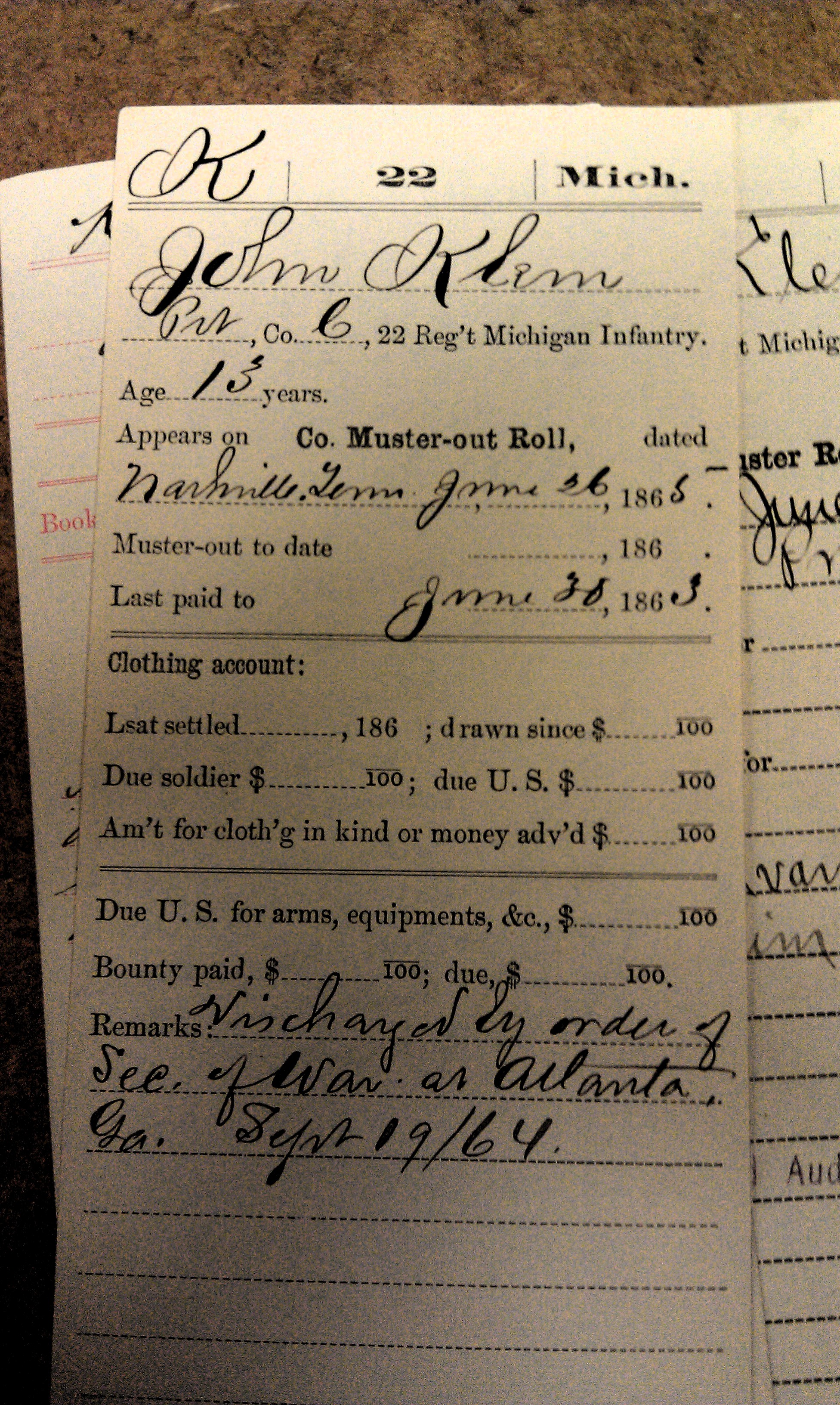
John Clem muster card
Muster card showing Clem
signed up under the name Klem
John Lincoln Clem was a soldier during the Civil War. He saw action at many battles, including the Battle of Chickamauga. He was a dedicated patriot and was known for his willingness to march right into battle, despite the dangers that surrounded him. He was also known as ‘Johnny Shiloh’ and ‘The Drummer Boy of Chickamauga.’ He was also only twelve years old when he enlisted in the Union Army.

John Lincoln Clem was born John Joseph Klem in Newark, Ohio on August 13, 1851. He decided to run away from home when he was a few months short of his tenth birthday. It was his intention to join up with the Union Army. He first tried to join up with the Third Ohio Volunteer Infantry Regiment, but his age kept them from accepting him. Still, the young man persisted.

Sources vary as to whether John Clem first joined up with the Twenty-Fourth Ohio Volunteer Infantry or the Twenty-Second Michigan Infantry Regiment. However, it was the men of the Twenty-Second Michigan Infantry Regiment who eventually started pooling money together to pay the young man. They gave him a position as their drummer boy. They also outfitted him with a uniform and a gun, which were modified to suit his small stature. John Clem was often said to have been small for his age. He may have looked like a seven-year-old boy on the battlefield.

It was in May of 1863 that John Clem was finally allowed to officially join the Union Army. He had already been present at several Civil War battles, by that time, if you can imagine such a thing. The Civil War was the bloodiest and most deadly ever fought by the United States. It is quite the thing to imagine a young child marching bravely into battle with his drum and his rifle. Nonetheless, that is what he did. There is a story that John Clem’s drum was hit by a canon at the Battle of Shiloh. However, this sounds a little dubious. If it had happened, he would’ve had to have been with a different regiment. The Twenty-Second Michigan Infantry Regiment was not formed until after the Battle of Shiloh.

John Clem was definitely present at the Battle of Chickamauga. He is credited with shooting and killing a Confederate colonel there, at point blank range. He may have also been captured at the Battle of Chickamauga. However, some sources say he was captured after the battle. Either way, he was relieved of his uniform, which, by all accounts, bothered him a great deal. He had a hat with three bullet holes in it (or so it is said) that was very dear to him. He was released in a prisoner exchange soon after he was captured. He also changed his name to John Lincoln Clem around this time.

John Clem was discharged in 1864. He went home after his discharge and completed his schooling. It wasn’t long before he started entertaining thoughts of rejoining the military, though. After his graduation from high school, he tried to enter West Point Academy, but had difficulties. He was eventually allowed to reenter the military anyway. He served until 1915, when he retired as a Major General.

John Clem earned himself the distinction of being the youngest ever noncommissioned officer in the United States Army after the Battle of Shiloh, when he was promoted to lance corporal. He was also the last Civil War veteran to retire from the Army. He passed away in San Antonio, Texas on May 13, 1937. He was laid to rest in Arlington National Cemetery in Virginia.

Sources

Johnny Klem, retrieved 12/18/09, ohiohistorycentral.org/entry.php?rec=85

John L. Clem, 1851-1937, retrieved 12/18/09, hmbd.org/marker.asp?marker=12579 (Page No Longer Exists)